

No, stammering is not shy. Shyness is a personality trait. Stammering (or stuttering) is a neuro-developmental speech disorder involving repetitions, prolongations and blocks in speech. A shy child may be perfectly fluent once they feel comfortable, while a child who stammers may be confident and social but still struggle to get words out. A trained Stammering Therapy centre in Rajendranagar, Patna can differentiate in a single assessment session.
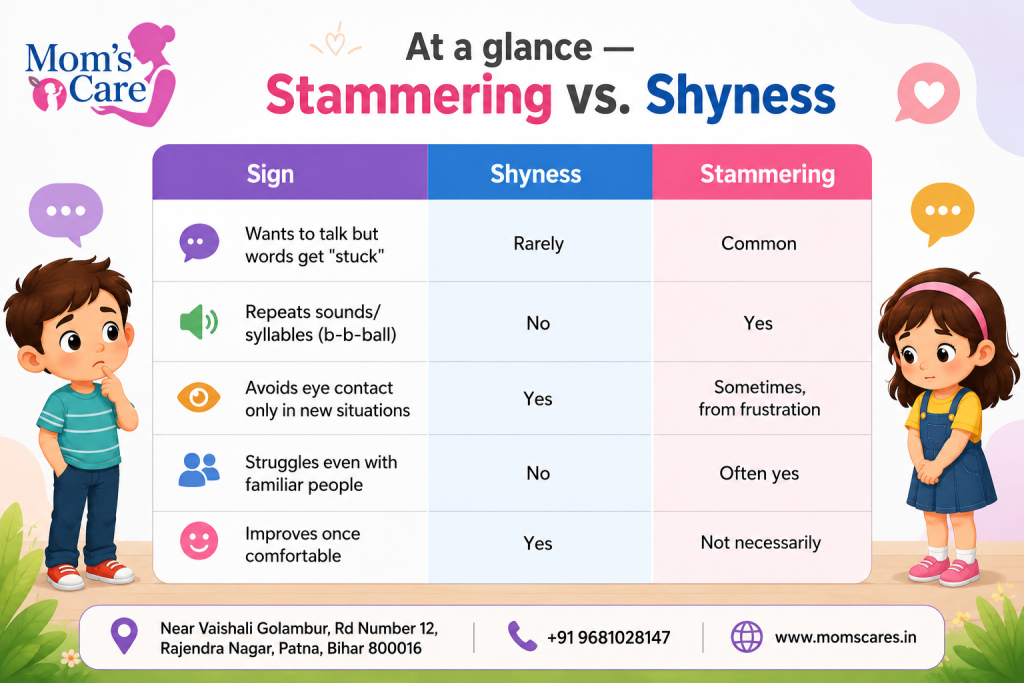
At a glance — Stammering vs. Shyness
| Sign | Shyness | Stammering |
|---|---|---|
| Wants to talk but words get “stuck” | Rarely | Common |
| Repeats sounds/syllables (b-b-ball) | No | Yes |
| Avoids eye contact only in new situations | Yes | Sometimes, from frustration |
| Struggles even with familiar people | No | Often yes |
| Improves once comfortable | Yes | Not necessarily |
Every week parents come to our centre in Rajendra Nagar, Patna and say almost the same thing. ‘Doctor, he is just shy, he’ll grow out of it’. Parents think this for a reason – a kid who hesitates before speaking, looks down or is quiet in a room full of relatives seems shy on the surface. But when that hesitation happens with repeated sounds, drawn out words or a sudden silence in the middle of a sentence, something more specific is going on in the brain’s speech-motor pathways, and shyness has very little to do with it.
This article explains how to differentiate, what the current research is saying about the causes of stammering, actual trends we observe in our practice, and how a committed Stuttering Therapy centre in Rajendranagar Patna develops a plan based on the actual needs of a child (or adult) – not a one-size-fits-all worksheet.
Shyness or Stammering? How to Tell the Difference
Shyness is an emotional response — a child may freeze up around strangers, a new teacher, or a stage, but talk freely at home. Stammering is a fluency disorder: it can happen even when the child is relaxed, talking to a parent or telling their favourite cartoon. The three classical patterns are:
Repetition – “I-I-I want water,” or repeating whole words
Prolongations – drawing out a sound, e.g. “Mmmmmmom”
Blocks — the mouth is ready to talk but no sound comes out for a second or two
If you see these patterns last more than 6 months, happen in a variety of settings, or with visible tension in the jaw, eyebrows or fists, it’s time for a proper evaluation, not to wait it out.
What Recent Research Says About Stammering
For decades, stuttering was considered a psychological oddity, something kids would just “grow out of” with confidence building. That’s a big change in thinking.
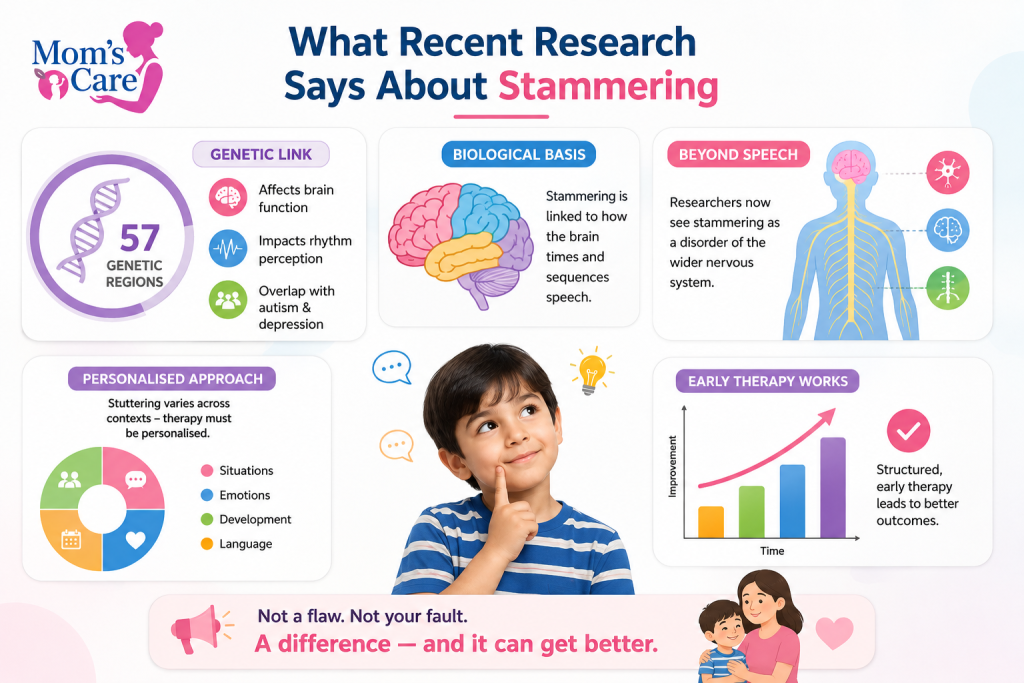
- In a huge genome-wide study published in Nature Genetics and covered by Science, the authors analyzed the genetic data of close to 100,000 people who stutter and found 57 genetic regions associated with an increased risk of stuttering, involving genes related to brain function and rhythm perception, and suggesting overlaps with autism and depression. This is one of the best evidence to date that stammering has a biological not a behavioral basis.
- Researchers at the University of Mississippi are now looking at stammering as a disorder of the broader nervous system, and not a simple speech problem, and are building new treatment strategies around that framework.
- In 2026, a review in Frontiers in Human Neuroscience proposed an integrative model to explain how the clinical, developmental and neurobiological features of stuttering vary according to linguistic, emotional and situational contexts, highlighting the need for therapy to be personalised rather than generic.
Simply put: your child’s stammer is not a character flaw, a parental error or a phase caused by nerves. That difference is the brain’s timing and sequencing of movements to produce speech, and that difference responds very well to structured, early therapy.
Recent News: Why This Conversation Is Growing Louder
Stammering has recently received unusual attention from the general public, and it is worth knowing why.
- The coverage this month describes a transition to “nerve-based stuttering” models of treatment, where clinicians no longer view adult stuttering as simply a matter of speech mechanics but as “an interaction between the nervous system, psychology, emotions, and communication habits”. Reports cite people who know what they want to say but experience speech blocks, repetitions, facial tension and communication anxiety, a pattern our therapists see often in working professionals who never had therapy as children.
- International Stammering/Stuttering Awareness Day is a worldwide campaign that takes place every October 22 to reduce stigma and promote speech therapy and communication skills development for people who stammer.
- Fluency research is also moving into digital tools—engineers and clinicians are trying out avatar-based practice environments to help students who stutter rehearse speaking situations with less real-world anxiety, an approach that’s showing up in recent fluency-disorder journals.
None of this is to suggest that a phone app or awareness post can replace professional care – but it does show that stammering is finally being taken with the clinical seriousness it deserves.
Real Patterns We See at Our Centre (Illustrative Examples)
Example 1 — The seven-year-old “shy” boy. A family came in with their son, thinking he was just shy at school. Assessment showed normal repetitions and jaw tension only with structured classroom speaking, not at home – textbook signs of situational stammering, not shyness. His classroom reading was much easier after six months of guided fluency-shaping sessions.
Example 2 – The adult who avoided phone calls. I met a 26-year-old software professional, who had been coping with his stammer by avoiding calls and presentations for years. He now leads client calls at work, working with our speech-language pathologist on breathing control, pacing and desensitisation techniques – a sign that stammering therapy isn’t just for kids.
Example 3 – The child confused for stuttering and pitch change We were referred a ten-year-old boy for stammering, and he also had a high-pitched voice for his age, a case that required intervention from our Puberphonia Therapy centre in Rajendranagar, Patna, together with fluency work, as voice pitch disorders and stammering can sometimes overlap and need to be assessed together.
How Therapy Actually Works
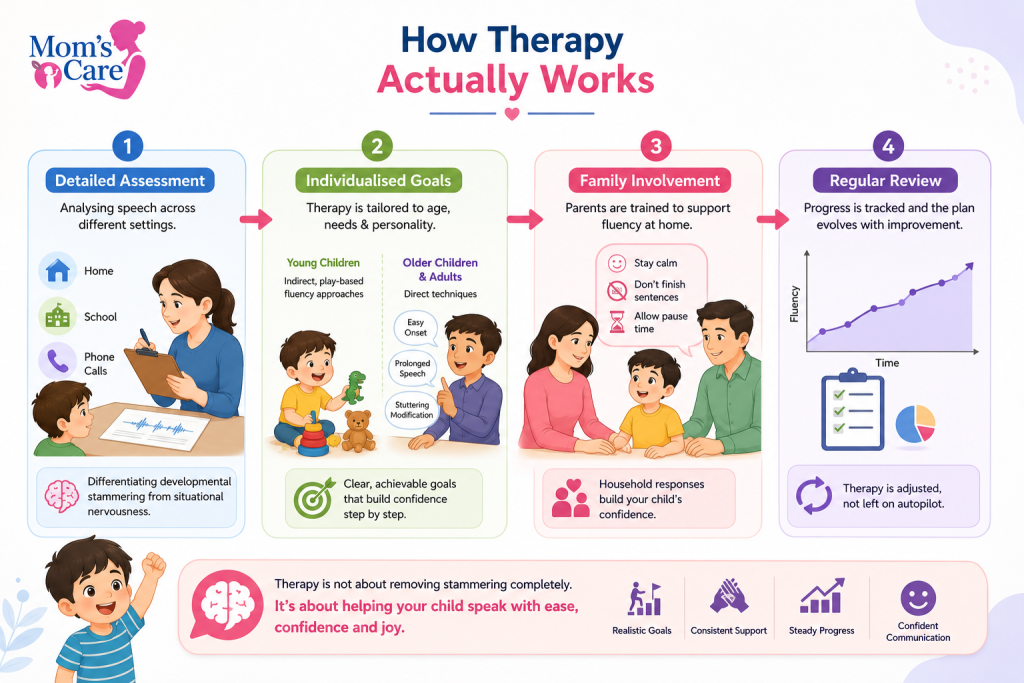
A responsible Stammering Therapy centre in Rajendranagar, Patna does not hand out generic breathing exercises and call it a plan. The process usually looks like this:
- Detailed assessment — analysing speech samples across different settings (home, school, phone calls) to separate developmental stammering from situational nervousness.
- Individualised goals — young children often benefit from indirect, play-based fluency approaches; older children and adults typically need direct techniques like easy onset, prolonged speech, and stuttering modification.
- Family involvement — parents are trained in how to respond during a block (staying calm, not finishing sentences, allowing pause time), since household reactions directly affect a child’s confidence.
- Regular review — fluency is tracked session by session, and the plan is adjusted as progress is made, not left on autopilot for months.
Beyond Stammering: Related Concerns We Also Treat
Speech and developmental difficulties rarely arrive in isolation, which is why families in Rajendra Nagar often need more than one kind of support under a single roof:
- Speech Therapy centre in Rajendranagar, Patna — for late talking, unclear articulation, language delay, and stammering together
- Stuttering Therapy centre in Rajendranagar, Patna — dedicated fluency-shaping and stammering-modification programs for children and adults
- Puberphonia Therapy centre in Rajendranagar, Patna — for teenagers and adults whose voice pitch hasn’t matured naturally after puberty
- Autism Treatment Center in Rajendranagar, Patna — structured behaviour and communication programs for children on the autism spectrum
- Autism Doctor in Rajendranagar, Patna — clinical evaluation and diagnosis by trained specialists before therapy begins
- Occupational Therapy centre in Rajendranagar, Patna — for fine motor skills, sensory processing, and daily-living independence
Having all of these under one address means a child doesn’t need to be shuttled between four different clinics across Patna for a related set of concerns — one team tracks the full picture.
What Parents Can Do Right Now
While waiting for a formal assessment, a few habits do help at home:
- Slow down your own speaking rate a little – children often copy the speaking rate of the adult who talks to them
- Allow your child to take their time over a sentence; don’t finish it for them
- Don’t say “slow down” or “take a breath” mid-block — it usually raises pressure rather than lowers it
- Praise the content of what was said, not the smoothness of delivery
- Keep a simple log of when stammering increases (tired, excited, new people) – this becomes valuable data for your therapist
Conclusion
Stammering is not a personality trait to wait out — it’s a speech-motor difference with a real, growing body of genetic and neurological research behind it, and real, structured therapy that helps. Whether it’s your child’s first few years of speech, a teenager’s changing voice, or an adult who has quietly avoided phone calls for a decade, the right support changes the trajectory. If what you’re seeing looks like more than shyness, an assessment is a better next step than more waiting.
Ready to get clarity on your child’s (or your own) speech?
📞 Call Us: +91 9681028147
💬 Mail Us on : info.momscares@gmail.com
info@momscares.in
📅 Book a Free Assessment: Contact Mom’s Care, Rajendra Nagar, Patna
Frequently Asked Questions
- Does stammering occur due to nervousness or shyness? No. Research shows a neurodevelopmental and genetic basis for stuttering. Nervousness can make an existing stammer more noticeable, but it is not the cause.
- When should I have my child assessed for stammering? Stuttering persists for more than six months, occurs in more than one setting, or is accompanied by visible tension. Early assessment (ages 2-6) typically leads to faster and longer lasting gains.
- Is speech therapy for stuttering still helpful for adults? Yes. Adults respond very well to fluency-shaping and stammering-modification techniques, as well as techniques to deal with speaking anxiety developed over many years.
- Does stammering relate to autism? In recent years genetic studies have found common areas of the genome between stammering and conditions like autism, but the two are different diagnoses and should be assessed separately.
- What is Puberphonia and is there any connection with stammering? Puberphonia is when a voice does not change naturally after puberty. Stuttering is a separate disorder from stammering, but both can occur in the same person and need to be treated together.
- Does Mom’s Care provide therapy for both children and adults? Yes. At our Rajendra Nagar centre, we provide therapy to children and adults in the areas of speech therapy, stammering & stuttering therapy, puberphonia therapy, occupational therapy and autism assessment and intervention.