
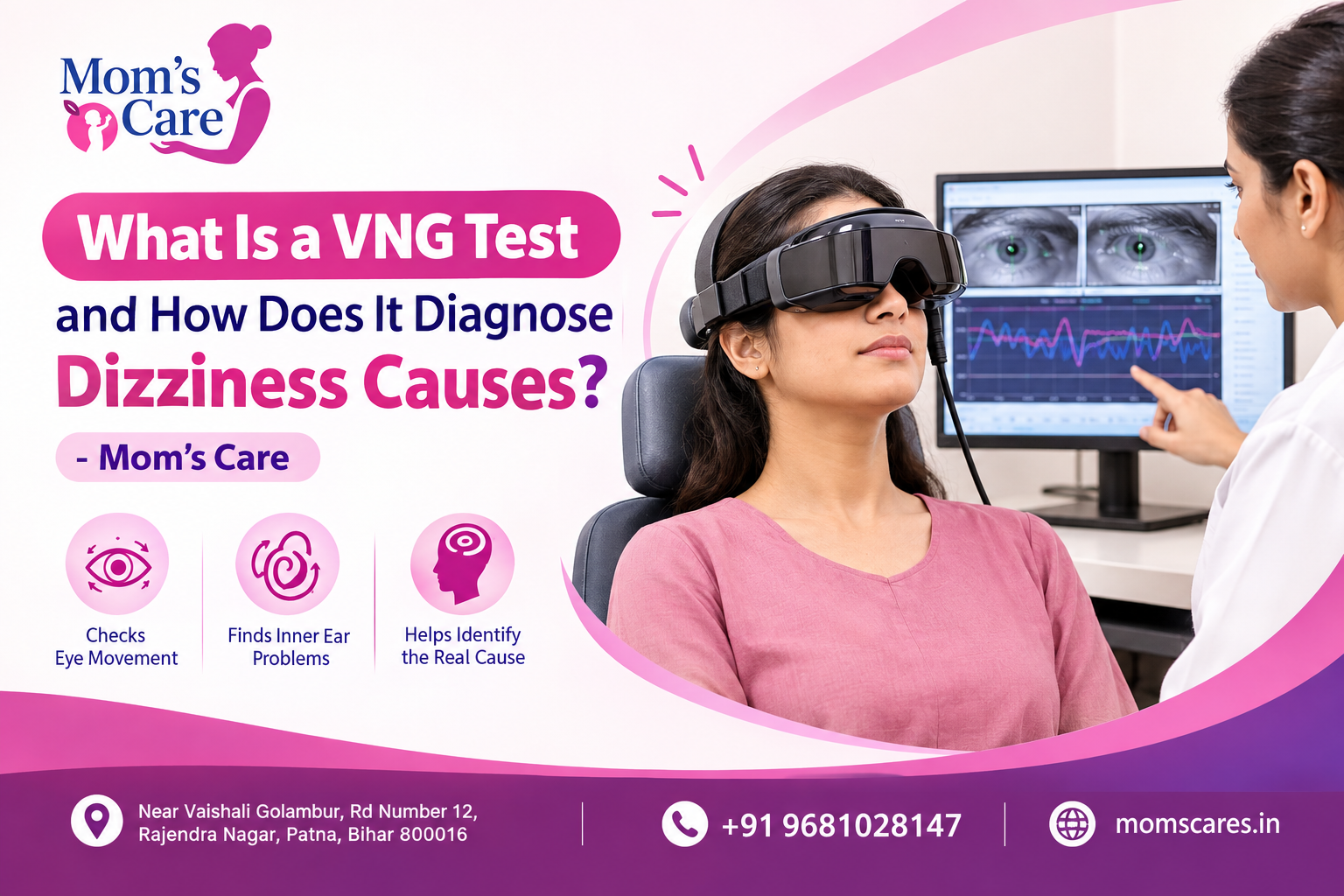
A VNG test (videonystagmography test) records your eye movements with infrared goggles while you follow lights, change head positions and, when suitable, have each ear gently stimulated. Because the inner ear and eyes are wired together, abnormal eye movements show which part of the balance system is causing the dizziness.
Key facts
- Time: about 45–60 minutes
- Comfort: no needles, no injections, no radiation
- Best for: spinning vertigo, dizziness when turning in bed, unsteadiness, suspected BPPV
- Report: same day at Mom’s Care
- Cost in Patna: roughly ₹1,200–₹4,500, depending on the package
How it works in four steps
- Your history is recorded and your ears are checked.
- Goggles are fitted and calibrated.
- You follow lights, hold still and move into set head positions.
- The recordings are analysed and the result is explained to you.
You roll over in bed and the room swings for ten seconds. Or you stand up too fast, and the floor tilts. Dizziness is easy to notice and hard to explain, and the word covers very different problems. A VNG test turns a vague feeling into measurable data.
What is a VNG test?
Videonystagmography is a computerised test that studies the link between your eyes, brain and inner-ear balance system. The goggles hold small cameras that track your pupils in real time, even in darkness. The test does not treat vertigo. It gives your clinician objective information so that repositioning, exercises or a medical referral can be chosen accurately.
Why the eyes reveal inner-ear problems ?
Each inner ear sends motion signals to the brain. The brain uses them to keep your vision steady when your head moves, a link called the vestibulo-ocular reflex. When one ear sends weaker or false signals, the eyes make small, rhythmic movements called nystagmus. You may never notice them, but the goggles do. The direction, speed and timing of these movements act like a fingerprint for different conditions.
How a VNG test diagnoses the causes of dizziness
A full videonystagmography test has four parts. Each one checks a different pathway.
- Oculomotor tests. You follow stationary and moving lights. Jerky or delayed tracking can point toward the brain rather than the ear.
- Spontaneous nystagmus. Eye movements are recorded while your head is still, with and without visual fixation.
- Positional testing. You are guided into positions such as Dix-Hallpike. This is where crystal-related dizziness (BPPV) usually shows itself.
- Caloric testing. When suitable, each ear is stimulated separately with warm and cool air or water. A weak response on one side suggests reduced inner-ear function. You may feel a brief spin that settles quickly.
A VNG test for vertigo and a VNG test for dizziness both use this same protocol. The difference is in interpretation: your symptoms decide which findings matter most.
Five patterns people recognise
These are illustrative scenarios, not individual patients.
- Spinning when you roll over in bed, lasting under a minute. This fits BPPV, where tiny crystals in the inner ear move out of place. Calcium carbonate crystals dislodge from the inner ear in BPPV. It is the commonest cause of true vertigo, and the Epley manoeuvre resolves symptoms for most people after one or two treatments. TimeThe Online GP
- Constant spinning for days after a viral illness. This may be vestibular neuritis, where caloric testing can show one ear responding weakly.
- Spells with ear fullness, ringing and fluctuating hearing. These need VNG and hearing tests read together.
- Dizziness with headaches and light sensitivity, and a normal VNG. A normal result is still useful because it points toward vestibular migraine or another cause.
- Near-falls in the dark, or vision that bounces while walking. Weak responses from both ears can explain this.

What 2026 research says
- VNG-guided care worked in a Bengaluru study. A 12-month prospective study of 80 vertigo patients, published in the Indian Journal of Otology in May 2026, described VNG patterns to separate central from peripheral vestibular disorders and reported 72.5% symptom improvement with VNG-guided care. It was a single-institution study with a modest sample, so larger multicentre work is still needed. Medical DialoguesMedical Dialogues
- AI is learning to read VNG traces. A team from Sydney published a delay-aware neural network in Scientific Reports in May 2026 that classifies BPPV automatically from video-nystagmography recordings. PubMed
- A June 2026 review found the technology is spreading. It covered about 50 papers and noted that classical machine-learning models reached up to 98.77% nystagmus recognition accuracy. It also noted that infrared video equipment is expensive and depends on specialists. That is a reason to choose a clinic that has both. DOIDOI
- VNG helps in tricky cases. A 2026 Frontiers case report described a patient with congenital nystagmus, vestibular migraine and right posterior-canal BPPV. After an Epley manoeuvre, the vertigo and unsteadiness had resolved by the 15-day follow-up. Frontiers
- Automated eye tracking is being tested for stroke clues. A 2026 outpatient study found skew deviation, a vertical eye misalignment, uncommon in dizzy patients but highly specific for central lesions. The automated video-oculography algorithm showed promise in detecting it. PubMed Central
In the news
- September 2026: University College London researchers studied 109 patients at a specialist dizziness clinic and found that different vestibular diagnoses come with distinct triggers, avoidance habits and coping strategies. Your own description of what sets off the dizziness is valuable information. BIOENGINEER.ORG
- September 22, 2026: TIME ran a feature on why people suddenly feel dizzy, describing how BPPV begins when calcium carbonate crystals dislodge in the inner ear. Time
- January 2026: The Vestibular Disorders Association highlighted residual dizziness, a lingering unsteadiness that many people feel for weeks or months even after BPPV maneuvers work. A successful repositioning does not always mean you feel fully normal straight away. Vestibular Disorders Association
- February 2026: Penn State Health reported that nearly 40% of US adults experience vertigo at least once. Penn State Health
- January 2026: An industry report described newer infrared goggles that help clinicians judge whether vertigo starts in the inner ear or the brain. World Pharma Today
Children and teens are not exempt. The VeDA notes that vestibular and balance disorders in children and teens are often overlooked. For a child with clumsiness, motion sickness or avoiding movement, a clinician can advise whether vestibular testing is appropriate. Vestibular Disorders Association
VNG compared with other balance tests
| Test | What it measures | Useful for | Limitation |
|---|---|---|---|
| VNG | Eye movements via infrared video | BPPV, one-sided weakness, central screening | Does not assess every vestibular organ |
| ENG | Eye signals via skin electrodes | Where video testing is unavailable | Cannot directly record torsional movement |
| vHIT | Fast head-movement reflex | Quick canal assessment | Does not replace positional testing |
| VEMP | Otolith and nerve responses | Selected otolith disorders | Depends on protocol and middle-ear health |
| Audiometry | Hearing thresholds | Hearing loss, Ménière’s-type symptoms | Does not measure balance directly |
| MRI or CT | Structure | Selected neurological concerns | A normal scan does not exclude inner-ear dysfunction |
These tests work together, not as substitutes.
Preparing and what to expect
- Eat a light meal about two hours before.
- Ask your doctor whether vertigo medicines should be paused. Never stop essential medicine without approval.
- Skip alcohol for 48 hours, and avoid caffeine and nicotine that morning.
- Leave off mascara, kajal and eyeliner, and wear spectacles instead of contact lenses.
- Bring a companion, because mild unsteadiness may linger briefly after caloric testing.
- Tell the clinic about eardrum perforation, ear discharge, recent ear surgery, pregnancy or serious neck or back pain.
The cost of delay
Waiting rarely makes dizziness safer. Untreated BPPV can keep triggering attacks and raise fall risk. Repeated self-medication can hide the pattern the test needs to see. Some people carry symptoms for years: AMA-published physician interviews mention a patient with 20 years of undiagnosed vertigo, while noting that most patients can be diagnosed and helped. One visit of under an hour can replace years of guessing. American Medical Association
VNG test near me: VNG test in Patna at Mom’s Care
Searching for a VNG test near me should come down to four questions. Who interprets the results? Is caloric testing available when suitable? Will you get a written report and explanation? Is treatment available after diagnosis?
Mom’s Care offers a VNG test in Patna at Near Vaishali Golambar, Road Number 12, Rajendra Nagar. Patients also come from Kankarbagh, Boring Road, Bailey Road, Danapur and Patna City. Families looking for an occupational therapy centre in Boring Road, Patna often ask us about balance testing too, and the same team can guide you on both.
Assessment is coordinated by Dr. Abhijeet Kumar, audiologist and speech-language pathologist, formerly at IGIMS Patna and AIISH Mysore. Consultation is in Hindi or English.
| Package | Indicative cost |
|---|---|
| Basic screening (about 30 min) | ₹4,500 |
| Complete VNG test (report and same-day counselling) | ₹2,000–₹3,500 |
| Full workup with audiometry and tympanometry | ₹3,000–₹4,500 |
Prices are indicative. Call to confirm current inclusions.
When VNG is not the right first step: sudden vertigo with slurred speech, facial or limb weakness, double vision, fainting, severe headache, chest pain or sudden hearing loss needs emergency care. A 2026 American Journal of Emergency Medicine meta-analysis reviewed the HINTS family of bedside eye-movement tests for identifying stroke in acute vestibular syndrome, which shows how carefully emergency teams treat this problem. ScienceDirect
FAQs
What is a VNG test?
A test that records eye movements with infrared goggles to evaluate dizziness, vertigo and inner-ear balance function.
Is the VNG test painful?
No. There are no needles or radiation. You may feel brief spinning or nausea during positional or caloric testing.
How long does it take?
Usually 45–60 minutes. Adding hearing tests takes longer.
Can a VNG test detect BPPV?
Yes. Positional recordings can show patterns that suggest BPPV and help identify the affected side and canal.
Is a VNG test for dizziness useful if my result is normal?
Yes. A normal result can steer the search toward vestibular migraine, PPPD, neck-related causes or medication effects.
Do I need a referral?
A referral helps but is not always required. It makes it easier to share results with your treating doctor.
Can I drive afterward?
It is safer to bring someone, since mild unsteadiness or nausea can continue briefly.
How much does a VNG test cost in Patna?
Roughly ₹1,200–₹4,500, depending on the package. Call for the current price.
Sources & Further Reading
- Muddaiah D, Shiraguppi R. Videonystagmography as an assessment tool in the evaluation of vestibular dysfunction. Indian J Otol 2026;32:124–9. News coverage: medicaldialogues.in/ent/news/videonystagmography-guided-care-yields-725-percent-vertigo-improvement-suggests-study-175241
- Chaturvedi K et al. Automated classification of BPPV from video-nystagmography using a delay-aware neural network. Sci Rep 2026;16:22586. doi:10.1038/s41598-026-52908-7
- Review of nystagmus and vertigo diagnostics: from pathological foundations to AI-driven telemedicine. Sensors 2026. doi:10.3390/s26123949
- Vestibular function assessment using vHIT and videonystagmoscopy in congenital nystagmus and vertigo: a case report. Front Audiol Otol 2026. doi:10.3389/fauot.2026.1917636
- Video-oculography-based detection of skew deviation in outpatient dizziness. PMC13511058 (2026)
- Ozdemir HN, Klopotovska I, Kaski D. What patients do when they feel dizzy. J Neurol 2026;273(10):587. doi:10.1007/s00415-026-14133-0
- Using the “HINTS family” to diagnose stroke in acute vestibular syndrome: systematic review and meta-analysis. Am J Emerg Med 2026;104:181–2.
- Vestibular Disorders Association, current research: vestibular.org/article/get-involved/participate-in-research/current-research/
- Penn State Health News, “Why am I so dizzy?” (2026): pennstatehealthnews.org/2026/01/the-medical-minute-why-am-i-so-dizzy/
- TIME, “The Strange Reason You May Suddenly Feel Dizzy” (Sept 22, 2026): time.com/article/2026/09/22/the-strange-reason-you-may-suddenly-feel-dizzy/
- Cleveland Clinic, Videonystagmography (VNG): my.clevelandclinic.org/health/diagnostics/22630-videonystagmography
- American Medical Association, “What doctors want patients to know about vertigo”: ama-assn.org
Associated data, methods, results
Associated data: No new clinical data was collected. Inputs were the Mom’s Care VNG page (services, prices, timings, clinician), one competitor page, and the published sources listed above.
Materials and methods: Sources were found by web search in September 2026 and cross-checked for date and relevance. Studies were summarised in plain language and cited to their originals. Clinic facts came only from your website.
Results: The article covers 5 research items, 5 news items, 5 illustrative examples, 1 comparison table, 1 pricing table, 8 FAQs, a cost-of-delay section, a disclaimer and CTAs, with all six keywords used.
Abbreviations: VNG (videonystagmography), ENG (electronystagmography), vHIT (video head impulse test), VEMP (vestibular evoked myogenic potential), BPPV (benign paroxysmal positional vertigo), PPPD (persistent postural-perceptual dizziness), HINTS (head impulse, nystagmus, test of skew), VOG (video-oculography), AI (artificial intelligence), CTA (call to action).
Conclusion
Dizziness has many causes, and guessing is slow. A VNG test gives your clinician measurable evidence: whether the problem sits in the inner ear, is positional, or needs neurological attention. The 2026 research adds weight to that value, from VNG-guided outcomes to AI tools that read the recordings. A normal result still helps by ruling out inner-ear causes and pointing toward others. If you have been living with vertigo, unsteadiness or repeated spells, a 45–60 minute videonystagmography test is a practical next step.
Ready to find the cause of your dizziness?
📞 Call Us: +91 96810 28147 | 💬 Message Us on WhatsApp | 📩 Book Online
Mom’s Care, Near Vaishali Golambar, Road Number 12, Rajendra Nagar, Patna 800016 · Mon–Sat, 9:00 AM–7:00 PM
Medical disclaimer
This article is general patient education. It does not replace individual medical advice, examination, diagnosis or treatment. Reference values, test suitability and treatment vary between patients. Do not start, stop or change medicines based on this article. Seek emergency care immediately for sudden vertigo with weakness, slurred speech, double vision, fainting, severe headache, chest pain or sudden hearing loss.