

Most toddlers say their first words by 12-15 months and combine two words by age two. If your child has fewer than 50 words by 24 months, isn't combining words by age two, or has stopped using words they once knew, this counts as a speech or language delay, and an evaluation by a certified speech-language pathologist is recommended rather than a “wait and watch” approach.
It was a two year old’s birthday party, a room full of relatives and the one question every parent dreads, “Beta, papa-mama bolta hai?” When your kid isn’t talking like the neighbor’s kid or your sister-in-law’s toddler, the worry stays in your chest long after the guests have gone. You begin Googling at midnight, comparing your child to videos online, wondering if you’re overreacting or if there is a real problem.
You’re not losing your mind. And you’re not the only one, either. Pediatric data indicates that nearly 1 in 5 toddlers shows some kind of late language emergence, according to the National Institutes of Health’s TALK initiative, a federally funded project that is entirely dedicated to understanding why some children start talking later than others. This guide discusses what a real delay is, what the latest research actually says, and what real progress looks like with the right supports in place early on.
Signs That Your Child May Be a “Late Talker”
A short checklist, often borrowed directly from paediatric screening tools, that parents can use at home:
- Not putting two words together (“more milk,” “go park”) by age two
- Even family members, not just strangers, struggle to understand you
- Using fewer words or sounds than the child previously used
- Limited eye contact, pointing, or gestures used with the speech pause
- No variation in the babbling (only a few repeated sounds) last 12 months
| Age | What’s Typically Expected |
| 12 months | First words, response to own name |
| 18 months | 10-20 words, points to ask for things |
| 24 months | 50+ words, two-word combinations |
| 30 months | Simple sentences, mostly understood by family |
| 36 months | 3-word sentences, understood by most listeners |
A child who is behind on this chart isn’t automatically diagnosed with a disorder — but it is the signal to get a proper assessment rather than wait.
What Recent Research Actually Says
Research into speech delay has moved fast in the past couple of years, and some of it directly challenges old assumptions.
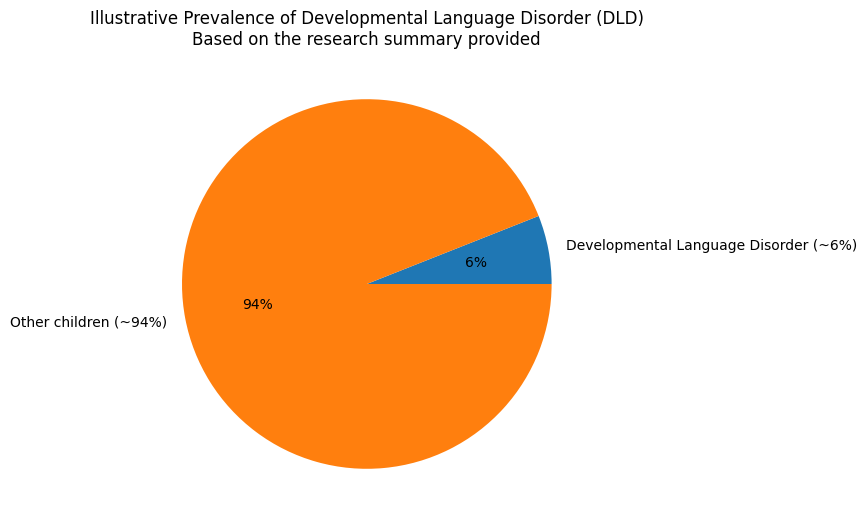
A 2026 paper in Frontiers for Young Minds examined why some toddlers begin talking later than others, suggesting that differences in how they use gestures early on and their patterns of vocabulary growth are early markers worth tracking, rather than just using age as the deciding factor. In a separate effort, Vanderbilt University’s Brain Development Lab is applying brain-imaging research to study children with language delay through the Late Talker Project. About 6% of all children experience developmental language disorder, a condition that can impact later reading and maths achievement if not addressed early. Their work underway is one of the first efforts to find a measurable, biological way to distinguish which “late talkers” are at real risk versus those who are likely to catch up on their own.
A big population study analysing data from 9,600 children, published by the American Speech-Language-Hearing Association, found that late talkers identified at 24 months were much more likely to have a smaller vocabulary still at 48 months, and this gap translated into school readiness at age five. The bottom line from this body of work is the same: while more than half of late talkers will eventually catch up, no one can tell in advance which child will and which won’t — and that’s precisely why early evaluation is more important than reassurance alone.
Screen Time News Items
This is one of the most discussed topics among Indian paediatricians at present, and rightly so.
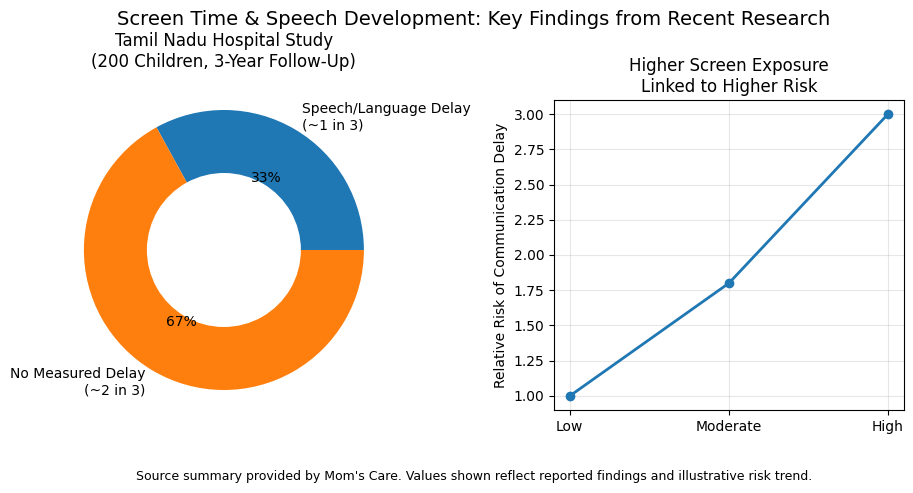
Doctors at Chandigarh’s PGIMER say they are now noticing a clear pattern in clinic – kids with higher daily screen exposure are increasingly showing up with speech delays. The department now recommends limiting screen time to two hours a day and encouraging face-to-face play instead. A further hospital-based study of 200 children in Tamil Nadu, published in 2026, followed the children for three years and found that about one in three had a measurable speech or language delay. The data also showed a clear dose-response relationship — more screen time generally increased the risk of delay, especially if a child was watching alone rather than with a parent narrating along. This is consistent with a large Japanese cohort study published in JAMA Pediatrics, that followed over 7,000 children and found that one-year-olds with high daily screen exposure were up to three times more likely to have communication delays by age two.
This is not to say that a tablet, in itself, will cause permanent damage. But it does mean screen habits are now considered a real, modifiable factor – not background noise – in virtually every speech evaluation.
What This Looks Like in Actual Families
Some patterns therapists see time and again:
His parents brought a boy of two and a half years old who understood every instruction, fetch the ball, close the door, but spoke only ten words. The classic pattern of expressive language delay is intact comprehension with lagging expression. Within a few months, his vocabulary jumped from single words to short sentences, with therapy built around his own play interests, not flashcards.
A three-year old girl, who was mostly silent at her play school, chatted freely at home with her grandmother. Teachers thought there was a language delay. But when assessed the true pattern was more like selective communication associated with environment and confidence and needed a very different approach than a child with an articulation or comprehension problem.
A child who had clear words at 14 months but by 20 months appeared to lose several of them. Word loss is a red flag all its own, separate from “never started talking,” and it’s precisely the sort of thing a comprehensive assessment is designed to identify early, not something a parent can try to parse on their own.
When to Stop Waiting and Seek an Evaluation
If your baby is over 18 months and has very few words, over 24 months and doesn’t say two-word phrases, has lost words they previously used at any age or just makes you feel uneasy when relatives say “boys talk late, don’t worry”, a rule of thumb is to make an appointment for a paediatric or speech-language evaluation. Trusting that instinct early, rather than waiting six more months, is always the difference between faster progress and a longer catch-up road down the line.
How a Speech Therapy Centre Can Help
Here is where a dedicated, hands-on speech therapy centre in Rajendranagar, Patna makes the difference between guesswork and a concrete plan. At Mom’s Care, each child undergoes a proper evaluation by certified speech-language pathologists, not a generic checklist. The evaluation includes vocabulary, articulation, comprehension and oral-motor function. Then, sessions are built on play. Sensory toys, structured games, and the daily routines the child already enjoys. Children learn language fastest when they are having fun, not when they are being drilled.
Parents are included in the therapy team, not spectators. Simple, practical strategies are shared for use at home between sessions — narrating daily routines, following the child’s interests rather than redirecting them, and building vocabulary through play rather than pressure — so progress doesn’t stop the minute a session ends. The team at the speech therapy centre in Rajendranagar, Patna, also works closely with occupational and behaviour therapists under one roof when a child needs more than just speech support so families are not running between different clinics across the city for related concerns.
Conclusion
A child who’s not talking yet is not a reflection of your parenting and it’s rarely something that just fixes itself by waiting longer. One thing the research agrees on is that early evaluation and early intervention give children the best shot at catching up. Waiting “just a little longer” is the one strategy that consistently shows up as a risk factor in long-term studies. If your child is displaying any of the signs above, the next right step isn’t another month of comparing with other toddlers — it’s a proper assessment by someone trained to tell the difference between normal variation and a delay that needs support.
Ready to Get Clarity on Your Child’s Speech Development?
| Call Us: +91 96810 28147 | Mail us: info.momscares@gmail.com info@momscares.in | Book an assessment: https://momscares.in/enroll-in-therapy-programs-moms-care-kankarbagh/ |
Frequently Asked Questions
1. At what age should I worry if my child isn’t talking?
If your child has fewer than 10-15 words by 18 months, fewer than 50 words by 24 months, or isn’t combining two words by their second birthday, it’s a good time for a professional evaluation rather than waiting further.
2. Can a late talker catch up without therapy?
Research shows that more than half of late talkers do eventually catch up on their own, but there’s currently no reliable way to predict which children will and which will continue to struggle, which is why an assessment is recommended instead of assuming it will resolve naturally.
3. Does screen time really cause speech delay?
Multiple recent studies, including hospital-based research in India and a large cohort study in Japan, have found a strong association between high screen exposure in toddlers and delayed expressive language. It isn’t usually the sole cause, but doctors now treat it as a significant, controllable factor.
4. Is speech delay the same as a language disorder?
Not always. A late talker typically understands language well and uses gestures, but has a smaller spoken vocabulary. A broader language delay or disorder often involves difficulty with understanding, behaviour, or social communication as well. A speech-language pathologist can tell the difference through a structured assessment.
5. What happens in the first session at a speech therapy centre?
The first visit usually involves a detailed assessment of your child’s vocabulary, articulation, comprehension, and oral-motor skills, along with a conversation with parents about developmental history. Based on this, a personal therapy plan and realistic goals are shared before sessions begin.
6. How long does speech therapy usually take to show results?
This varies by child and the type of delay, but many families begin noticing small, measurable changes — a few new words, clearer sounds, more attempts at communication — within the first few months of consistent sessions combined with home practice.