

⚡ Quick Answer — What Is a Sensory Room in an OT Centre?
A sensory room is a specially designed, safe space inside an occupational therapy centre, equipped with lights, textures, swings, bubble tubes, and sound tools that help children with autism or sensory processing difficulties self-regulate, reduce anxiety, and build focus. At Mom’s Care — a leading Occupational Therapy centre in Rajendranagar, Patna — our sensory rooms are built around each child’s unique needs, not a one-size template.
- Who benefits: Children with autism spectrum disorder (ASD), ADHD, sensory processing disorder (SPD), developmental delays
- Core goal: Help the child’s nervous system reach a “just right” state before or during therapy
- Types at Mom’s Care: Calming room, sensory gym, Snoezelen-inspired multi-sensory corner
- Outcome: Better focus, reduced meltdowns, improved participation in daily activities
Why Sensory Overwhelm Is the #1 Hidden Barrier for Children with Autism
Imagine walking into a room where every sound feels amplified, every light stings your eyes, and the fabric of your shirt feels like sandpaper on your skin. For many children with autism, this is not imagination — it is their daily reality. Sensory processing difficulties affect up to 90% of children on the autism spectrum, yet most families in Patna don’t realise this is a treatable, manageable challenge.
At our Occupational Therapy centre in Rajendranagar, Patna, we see this pattern week after week: parents arrive frustrated because their child “won’t cooperate” in therapy or has meltdowns in school. The root cause is almost always unaddressed sensory dysregulation — and a well-designed sensory room is one of the most powerful tools to resolve it.
🔬 Research Spotlight — 2025
A 2025 study published in Frontiers in Psychiatry called sensory processing difficulties “one of the most pervasive yet underrecognised challenges in autism” and urged all specialised autism centres and neurodevelopmental clinics to implement targeted sensory interventions as a standard part of care. The researchers found that environments adapted to sensory needs directly improved a child’s learning and social engagement.
This is exactly why Mom’s Care invested in dedicated, safe sensory rooms — not as an add-on, but as the foundation of our occupational therapy work.
What Makes Our Sensory Rooms Different — A Closer Look
Many therapy centres in Patna have a swing or a ball pit and call it a “sensory area.” A genuine sensory room is different. It is purposefully designed, regularly updated with evidence-based equipment, and, most importantly, used by a trained occupational therapist who knows your child’s sensory profile.
At our Occupational Therapy centre in Rajendranagar, Patna, our sensory rooms include the following evidence-supported zones:
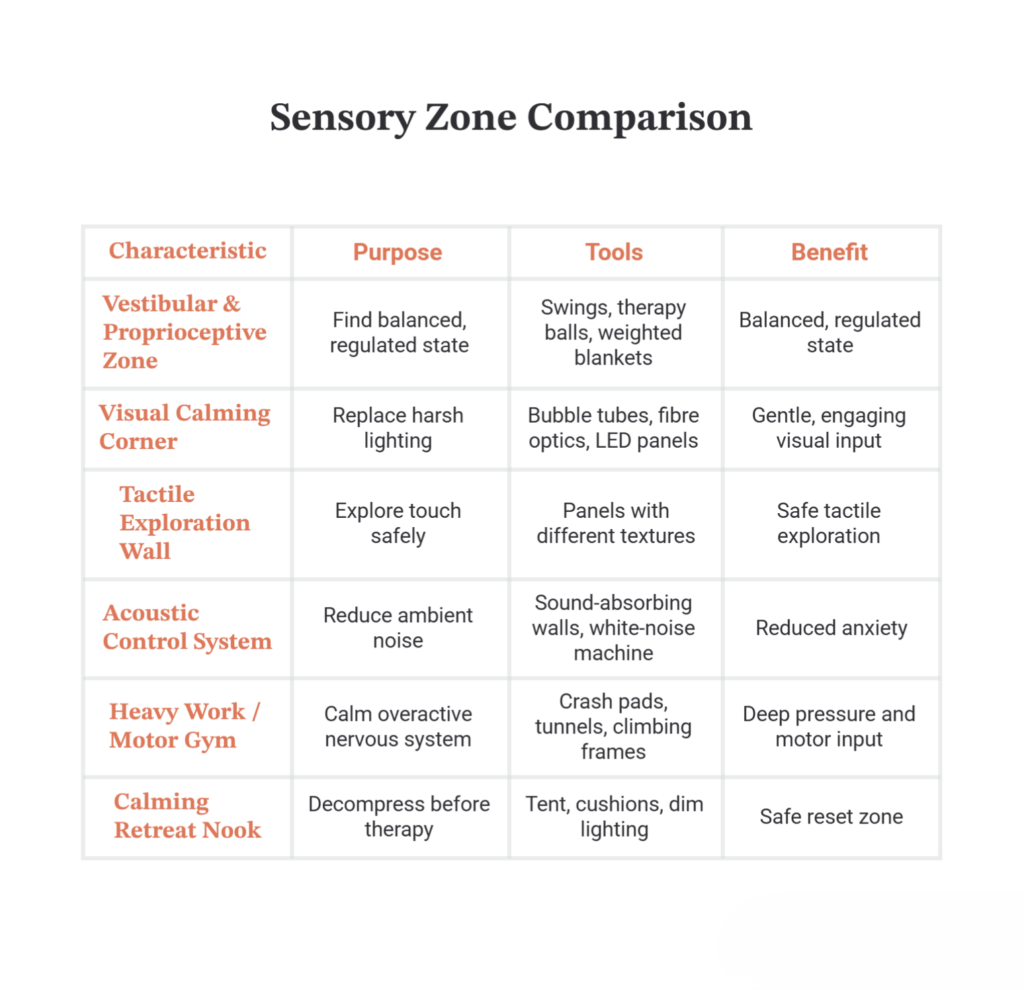
3 Children Whose Lives Changed After Sensory Room Therapy at Mom’s Care
Statistics matter, but every parent reading this needs to know what sensory room occupational therapy actually looks like for a real child in Patna. Here are three anonymised stories from our centre.
🧒 Story 1 — Arjun, Age 5, Autism Spectrum Disorder Arjun arrived at our Autism Treatment Center in Rajendranagar, Patna refusing to enter any room with fluorescent lighting. He would drop to the floor, cover his ears, and cry. Within three months of weekly sessions in our visual calming corner, paired with an individualised sensory diet prescribed by our occupational therapist, Arjun was not only tolerating standard lighting but was making eye contact and joining group activities. His mother described it as “watching a different child emerge.”
👧 Story 2 — Priya, Age 7, ADHD & Sensory Seeking Behaviour Priya would crash into furniture, touch everything, and could not sit for more than two minutes in a classroom. Her teacher assumed it was “bad behaviour.” Our Autism Doctor in Rajendranagar, Patna and OT team assessed her as a sensory seeker — a child whose brain craves more input, not less. We introduced heavy-work activities through our motor gym before each therapy session. Within six weeks, her classroom sitting time improved from 2 minutes to 18 minutes. Her school reported a 60% reduction in disruptive incidents.
🧒 Story 3 — Rohan, Age 9, Sensory Processing Disorder Rohan had a severe aversion to touch and refused to eat many foods due to texture sensitivity. Mealtimes were a family crisis every single day. Our OT team used our tactile exploration wall combined with gradual desensitisation techniques over 16 sessions. By month four, Rohan was trying new foods and — for the first time — allowing his mother to give him a hug. “I never thought I’d feel him hug me back,” she told us. “This centre gave me my son.”
Latest Research & News on Sensory Rooms in Occupational Therapy
For parents making decisions about their child’s care, it is important to know that sensory room therapy is not a trend — it is grounded in a growing body of peer-reviewed evidence.
🔬 Research 1 — University of Salerno, January 2025 A randomised study published in Pediatric Reports found that training in a Motor Sensory Room significantly improved sensory integration, motor coordination, and social interaction in children with ASD. The researchers concluded that sensory and motor training in a dedicated room “improves outcomes in a way that conventional therapy rooms alone cannot replicate.”
🔬 Research 2 — Wiley Autism Research, August 2025 A major comparative trial published in Autism Research journal compared Occupational Therapy using Ayres Sensory Integration (OT-ASI) with ABA therapy. The study confirmed that OT-ASI led to measurable improvements in children’s daily living participation and that the two approaches work best when combined — precisely the integrated model we follow at Mom’s Care.
📰 Recent News 1 — India’s Growing Autism Awareness, 2025 India’s Ministry of Social Justice and Empowerment has increased allocations for early intervention therapy centres across Tier-2 cities in Bihar and Jharkhand in 2025, recognising that access to specialist OT and autism therapy in cities like Patna has historically been limited. Parents in Rajendranagar and Kankarbagh no longer need to travel to Delhi or Mumbai — expert sensory therapy is available right here.
📰 Recent News 2 — SAGE Journal, 2025 A 2025 systematic review in SAGE Autism journal examined multi-sensory environments (MSEs) for children and adults with ASD across multiple countries. The review found that sensory rooms delivered by trained occupational therapists — not just any staff member — produced the most consistent improvements in sensory regulation and emotional well-being, underscoring the importance of choosing a qualified OT centre.
📰 Recent News 3 — American Journal of Occupational Therapy, 2025 A January 2025 call-to-action article in the American Journal of Occupational Therapy urged OT centres to formally integrate Ayres Sensory Integration into therapy programmes for school-age children with autism — noting that school readiness improves most when sensory work starts in a clinical setting before carrying over to the child’s school and home environment.
How Our Sensory Rooms Work Inside an OT Session — Step by Step
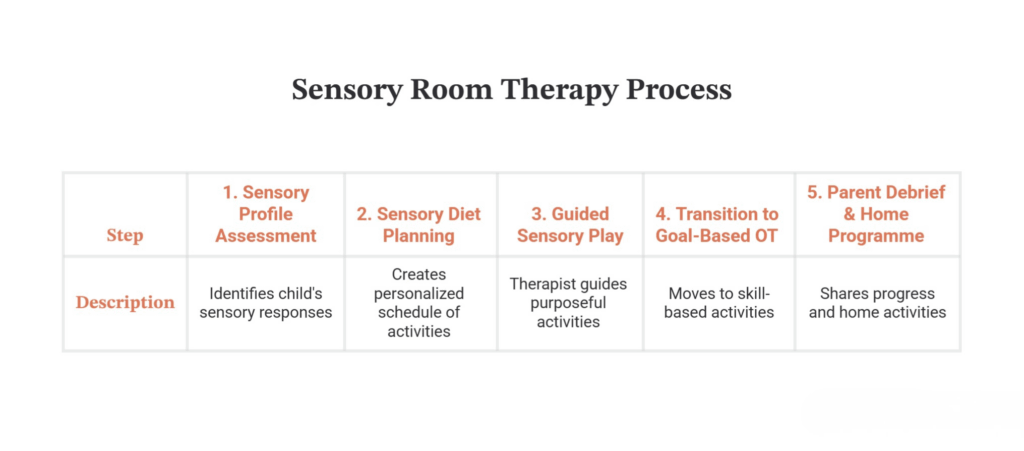
Parents often ask: “Does my child just play in the sensory room?” The answer is no — and that distinction matters enormously. Here is how a typical session unfolds at our Occupational Therapy centre in Rajendranagar, Patna:
Step 1 — Sensory Profile Assessment
Before a child enters our sensory room for therapy, our occupational therapist conducts a detailed Sensory Profile Assessment. This identifies whether your child is a sensory avoider, a sensory seeker, or shows mixed responses across different senses. This profile guides every decision about which equipment and activities to use.
Step 2 — Sensory Diet Planning
A “sensory diet” is not about food — it is a personalised schedule of sensory activities throughout the child’s day. Our OT team, working alongside the Autism Doctor in Rajendranagar, Patna at our centre, creates a home-and-clinic sensory diet so that the benefits your child gets in the sensory room carry over to school and family life.
Step 3 — Guided Sensory Play in the Room
Each session involves the therapist actively guiding the child through purposeful activities — not free play. The therapist observes responses in real time, adjusts stimulation levels, and uses the child’s reactions as data to refine future sessions. Safety is maintained at all times, and the child is never forced into uncomfortable activities.
Step 4 — Transition to Goal-Based OT Activities
Once the child’s nervous system is regulated — which usually takes 15–20 minutes in the sensory room — the therapist transitions to goal-based OT work: handwriting, self-care tasks, social interaction, or fine motor skills. A regulated child learns and retains skills 3–4× faster than one in a dysregulated state.
Step 5 — Parent Debrief & Home Programme
Every session ends with a brief parent debrief. We share what worked, what the child responded to, and give simple home activities to reinforce progress. At Mom’s Care, parents are partners — not just observers.
Conclusion — Your Child’s Calm Is Not Out of Reach
Sensory challenges do not have to define your child’s future. When a child’s nervous system gets the right input, in the right environment, guided by the right therapist — the results can be life-changing. At Mom’s Care, our Occupational Therapy centre in Rajendranagar, Patna, we have built sensory rooms not just with equipment, but with empathy. Every swing, every soft light, every textured panel exists for one reason: so your child can feel safe enough to grow.
Whether your child has been diagnosed with autism, is being assessed for ADHD, or is simply struggling with sensory sensitivities that make daily life harder than it should be — our team is ready to help. With certified occupational therapists, an experienced autism doctor, and a welcoming, child-friendly space in Rajendranagar, Patna, Mom’s Care is the specialist support your family has been looking for.
The first step is the hardest. The free assessment takes 30 minutes. The progress can last a lifetime.
Take the first step today — book your child’s free sensory assessment at Mom’s Care, Rajendranagar, Patna.
Call us now: +91 96810 28147
Mail us : info.momscares@gmail.com
info@momscares.in
Book Free Assessment: https://momscares.in/enroll-in-therapy-programs-moms-care-kankarbagh/
📍 Near Vaishali Golambur, Rd No. 12, Rajendra Nagar, Patna 800016 | Mon–Sat 9AM–7PM
FAQs — Sensory Rooms & Occupational Therapy in Rajendranagar, Patna
Q. What is the difference between a sensory room and a play area?
A. A sensory room is a clinically designed therapeutic environment with specific equipment chosen to address a child’s individual sensory profile. Every activity within it is guided by a trained occupational therapist with a clear goal. A play area, by contrast, has no therapeutic intent or clinical oversight. At our Occupational Therapy centre in Rajendranagar, Patna, our sensory rooms are used as active therapy tools — not recreational spaces.
Q. How do I know if my child needs sensory room therapy?
A. Signs your child may benefit include: extreme reactions to sounds, lights, or textures; frequent meltdowns in crowded or noisy places; crashing into objects or seeking intense physical input; avoiding touch or certain clothing; difficulty sitting still or focusing. A formal Sensory Profile Assessment at our centre, conducted by our Autism Doctor in Rajendranagar, Patna and OT team, will give you a clear answer.
Q. Is sensory room therapy only for children with autism?
A. No. While sensory room therapy is highly beneficial for children diagnosed at our Autism Treatment Center in Rajendranagar, Patna, it is equally effective for children with ADHD, sensory processing disorder, developmental delays, anxiety, and cerebral palsy. Any child whose nervous system struggles to process sensory input efficiently can benefit.
Q. How many sessions does it take to see results?
A. Most families notice initial improvements in emotional regulation within 6–8 sessions. Meaningful, lasting functional changes in daily living, school performance, and communication typically develop over 3–6 months of consistent therapy. Frequency, severity of the child’s profile, and family involvement in the home programme all influence the pace of progress.
Q. Does Mom’s Care also offer Puberphonia therapy along with OT?
A. Yes. Mom’s Care offers Puberphonia Therapy in Rajendranagar, Patna through our specialist speech therapy team. Puberphonia (also called mutational falsetto) is a voice disorder where the voice pitch remains inappropriately high after puberty. Our audiologists and speech-language pathologists work collaboratively with our OT team to provide integrated care for adolescents with complex needs.
Q. Can parents observe the sensory room sessions?
A. Yes — with guidance. At Mom’s Care, we believe parents are partners in therapy. We encourage parents to observe sessions and participate in the closing debrief. However, for some children, a parent’s presence in the sensory room itself can alter their behaviour. Our therapists will advise the best approach for your specific child after the initial assessment.
Q. How do I get started at Mom’s Care?
A. Simply call us at +91 9681028147, message us on WhatsApp, or click the “Book Free Assessment” button above. Our first step is always a free, no-obligation assessment to understand your child’s needs before recommending any therapy plan. We are located at Near Vaishali Golambur, Rd No. 12, Rajendra Nagar, Patna — easily accessible from Kankarbagh, Boring Road, and Rajendranagar.