

- What is it? Puberphonia is when a teenage boy’s voice stays high-pitched even after his body has finished puberty.
- Is it physical? Usually not — the vocal cords have matured normally. The habit of speaking in a high pitch is what needs correcting.
- Can it be fixed? Yes, in most cases, through structured voice therapy with a trained speech-language pathologist — no surgery required.
- How long does therapy take? Many teens see a noticeable pitch shift within a handful of sessions, with full stabilisation over a few weeks to a couple of months.
- Where to get help in Patna? A dedicated Puberphonia Therapy centre in Rajendranagar, Patna can assess and treat this with a customised plan.
When a Voice Doesn’t “Catch Up” With the Body
Approximately between the ages of 13 and 16 a boy is supposed to have his voice drop. The vocal cords lengthen, the larynx grows and in a few months a child’s voice takes on an adult register. For most teens, it happens without any awareness that it is happening at all.
But for a smaller subset of teens, that drop never really happens. The body has done its job — the vocal cords have matured — but the voice continues to come out thin, high, sometimes breathy or strained. This condition has a name: puberphonia, or mutational falsetto. This is not uncommon, and it is not something a teenager can simply “will” themselves out of. Usually it must be treated as any learned muscular habit must be treated: by directed re-training.
If you’re a patna parent googling this at midnight because your son got teased at school again, here’s what really helps – and where to get it.
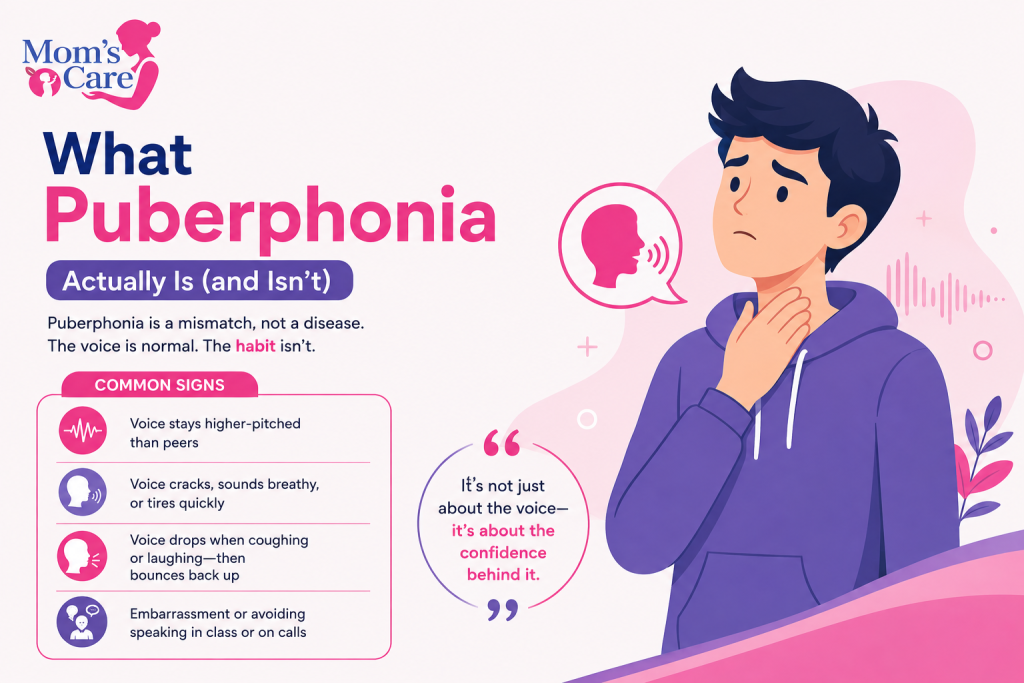
What Puberphonia Actually Is (and Isn’t)
Puberphonia should be understood as a mismatch, not a disease. The physical hardware, the vocal folds, has developed properly. What is still the same is the habit: the brain and laryngeal muscles are still running the “childhood voice” program, keeping the pitch artificially high thru learned muscular tension.
Research into the condition supports this. In a study of puberphonic patients, the laryngeal musculature often exhibited measurable over-tension and increased aerodynamic effort when compared to age-matched peers, even when the vocal folds were functioning normally. Therefore, the teenager is not trying to sound normal, he is trying to sound like he did when he was 11.
Typical symptoms include:
- A voice that remains substantially higher in pitch than peers, well after the onset of visible puberty changes (facial hair, height, Adam’s apple)
- Voice breaks, becomes breathy, tires easily in prolonged conversation.
- A voice that suddenly drops when coughing, clearing the throat or laughing — then comes back up when speaking normally
- Increased self-consciousness, social withdrawal, or reluctance to speak in class or on the phone
That last symptom can be as important as the voice. Adolescents with puberphonia commonly report embarrassment on phone calls, being mistaken for a much younger sibling, or avoidance of oral presentations altogether. The psychological weight of this condition is a real part of what any Speech Therapy center in Rajendranagar, Patna should be addressing, not just the acoustics.
Why It Happens
So there is no one cause and in most cases no structural abnormality at all. Contributing factors that a trained clinician looks for are:
- Attachment to a childhood voice- sometimes connected to anxiety about growing up or a family environment where a higher voice drew positive attention.
- Habitual muscle patterning – the laryngeal muscles just never “practiced” the lower register, so the higher pitch becomes the default groove.
- Hearing-related factors – in a small number of cases, difficulties with hearing during the pubertal window can interfere with a child’s ability to correctly imitate the deepening voices around him.
- Modeling and environment — a boy who is mostly surrounded by higher-pitched voices (younger siblings, a home where he is rarely speaking around adult men) may just not have a template to match.
Real structural or hormonal causes are rare in boys, so voice therapy is the first and usually only treatment necessary, not medication or surgery.
What Effective Therapy Actually Looks Like
Proper evaluation begins with a perceptual and acoustic assessment—where a speech-language pathologist will listen to your teen’s speaking voice, coughing and laughing (to see that the lower pitch is physically accessible), and may use pitch-analysis software to document the baseline.
From that point, treatment usually includes a combination of:
- Digital manipulation / laryngeal repositioning – short, gentle external techniques to help a teen find and feel his natural, lower pitch for the first time
- Pitch-lowering exercises (structured vocal exercises that gradually lower the habitual speaking pitch, and then lock it in thru repetition
- Auditory feedback training – teens listen to recordings of their own voice at different pitches, developing the self-monitoring skill needed to maintain the new voice outside of therapy
- Carryover practice – structured homework to make the new pitch automatic in real conversations and not just in the clinic.
The clinical literature on puberphonia rehabilitation is indeed promising. In a rehabilitation study of patients between 16 and 34 years of age under structured phoniatric and voice therapy, persistent improvement of voice quality as well as patient-rated quality of life was found afterward.
Separate acoustic research measuring patients pre- and post- a four-week voice therapy program documented measurable gains in vocal stamina (maximum phonation time) and normalization of breath-pressure patterns during speech – concrete, measurable evidence that the muscles are relearning the right pattern, not just “sounding better” subjectively.e relearning the right pattern, not just “sounding better” subjectively.
Illustrative Examples: What This Looks Like in Practice
- Scenario 1: A 15-year-old is mistaken for his mother on phone calls. Within eight sessions of pitch-lowering and auditory feedback work, his baseline speaking pitch drops into the expected male range and holds during unstructured conversation.
- Scenario 2: A 17-year-old refuses to answer questions in class because of snickering. Therapy addresses both the vocal habit and confidence-building through gradual, low-pressure speaking practice, with the family reporting renewed classroom participation within a few weeks.
- Scenario 3: A 14-year-old’s voice was normal on some days and squeaky on others. Assessment reveals the fluctuation was tied to fatigue and tension; targeted relaxation and pitch exercises stabilise the voice within a month.
- Scenario 4: A college-aged student who avoided the condition for years finally seeks help; his older age doesn’t prevent progress — it simply means therapy takes a bit longer to override a deeply ingrained habit.
Puberphonia, Stammering, and Related Concerns: Why the Right Clinic Matters
Voice and speech disorders in children rarely occur in isolation. The boy with puberphonia may also have a history of disfluency, or a younger sibling may be exhibiting early signs of stuttering. That’s why it helps to work with a center that can address the full range of developmental communication needs under one roof – a Stammering Therapy center in Rajendranagar, Patna and a Stuttering Therapy center in Rajendranagar, Patna should ideally be next door to voice therapy services, so families don’t have to shuttle between unrelated clinics for related issues.
The same goes for developmental care in a broader sense. Families seeking Autism Treatment Center in Rajendranagar, Patna, Autism Doctor in Rajendranagar, Patna or Occupational Therapy center in Rajendranagar, Patna often prefer to work with one clinical team that understands the child’s complete history of development rather than beginning anew with each visit.
Comparing Your Options
| Approach | What It Involves | Typical Outcome | Invasiveness |
|---|---|---|---|
| Voice therapy (SLP-led) | Structured pitch, breath, and auditory feedback exercises over weeks | High success rate; natural, stable voice; teen learns self-monitoring | Non-invasive |
| Self-guided online exercises | Humming, pitch-glide videos practiced without supervision | Inconsistent; risk of vocal strain; no correction of technique errors | Non-invasive but unmonitored |
| Counselling alone (no voice work) | Addresses anxiety/confidence without direct pitch retraining | May help emotional impact but rarely changes the voice itself | Non-invasive |
| Surgical intervention (e.g., thyroplasty) | Structural alteration of the larynx | Reserved for cases unresponsive to therapy | Invasive, surgical risk |
For the large majority of teenagers, professional voice therapy sits at the sweet spot: effective, non-invasive, and addressing both the physical habit and the confidence that comes with fixing it.
The Cost of Waiting
The greater the duration that puberphonia is left untreated, the less likely it is to resolve without intervention. As a family waits longer, two things tend to happen. The automatic high-pitch pattern becomes more ingrained and harder to break. The social impact compounds — missed phone calls, skipped class participation, and withdrawal from friend groups become more entrenched habits in their own right. The earlier you start therapy, ideally as soon as the mismatch is identified after puberty, the shorter and simpler the treatment course will be than if therapy is started years later.
Sources & Further Reading
The clinical claims in this article are based on the following peer-reviewed and clinical sources:
- Liang FY, Huang XM, Chen L, et al. “Voice Therapy Effect on Mutational Falsetto Patients: A Vocal Aerodynamic Study.” Journal of Voice, 2017;31(1):114.e1–114.e5. — PubMed
- “The Effect of Phoniatric and Logopedic Rehabilitation on the Voice of Patients with Puberphonia” — rehabilitation outcomes in 18 patients aged 16–34. PMC (National Library of Medicine)
- Dagli M, Sati I, Acar A, et al. “Mutational Falsetto: Intervention Outcomes in 45 Patients.” Journal of Laryngology & Otology, 2008;122(3):277–281. — PubMed
- “Voice Therapy Effect on Mutational Falsetto Patients: A Vocal Aerodynamic Study” (full text with comparative discussion) — ScienceDirect
- “Voice Therapy in Mutational Falsetto: A Narrative Review” — synthesis of 11 clinical studies on voice therapy outcomes. ScienceDirect
Medical Disclaimer
This article is solely for educational purposes and not a substitute for professional medical advice, diagnosis, or treatment. Each child presents differently with puberphonia and should only be diagnosed and treated after face-to-face assessment by a qualified Speech-Language Pathologist or ENT. If you are concerned about your teen’s voice, please consult a licensed clinician before starting any exercise program.
Frequently Asked Questions
- At what age should we be concerned if a boy’s voice hasn’t dropped? If visible puberty changes (growth spurt, facial hair, Adam’s apple development) are clearly present but the voice remains noticeably high a year or more later, it’s reasonable to seek an evaluation.
- Can puberphonia go away without therapy? It’s uncommon. Because the pattern is muscular and habitual rather than physical, most cases need structured retraining to resolve rather than resolving spontaneously.
- Is puberphonia the same as a voice that just “hasn’t broken yet”? Not quite. A voice that is still in the process of naturally deepening is different from a voice that has stalled entirely despite the body otherwise completing puberty. An assessment can tell the two apart.
- Does therapy hurt or strain the voice? No. Supervised voice therapy is specifically designed to reduce vocal strain, not add to it — which is also why self-guided exercises without professional monitoring are riskier.
- How many sessions does treatment usually take? It varies by case, but many teenagers show a measurable pitch shift within the first several sessions, with continued sessions used to stabilise the new voice under everyday speaking conditions.
- Do girls get puberphonia too? It’s far more common in boys, but it can occur in girls in rare cases, and the same evaluation and therapy principles apply.
In Closing
A teenager’s voice carries more than sound — it carries confidence, identity, and how comfortable he feels being heard. Puberphonia is treatable, usually without surgery, and usually faster than families expect once they start. If your son’s voice hasn’t matched the rest of his growth, that’s not something to wait out quietly. A proper assessment at a dedicated Puberphonia Therapy centre in Rajendranagar, Patna is the first step toward a voice that finally matches who he’s becoming.
📞 Ready to talk to a specialist?
Call Us Now: +91 9681028147
Mail us: info.momscares@gmail.com
info@momscares.in
Book a Free Assessment: https://momscares.in/enroll-in-therapy-programs-moms-care-kankarbagh/